

No, we are not talking about the headline making performance by Bad Bunny. We are talking about a market battle that is redefining the future of AI and advertising. While many expected competition on the turf, the real clash happened between Claude and ChatGPT, with sharp messaging that quickly made waves.
Anthropic Fires an Anti Ad Missile
This year, Anthropic, the company behind Claude, leveraged the Super Bowl’s premium advertising stage to deliver a pointed message to its main rival: OpenAI.
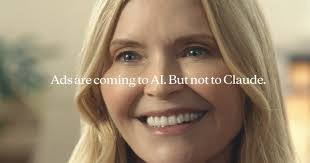
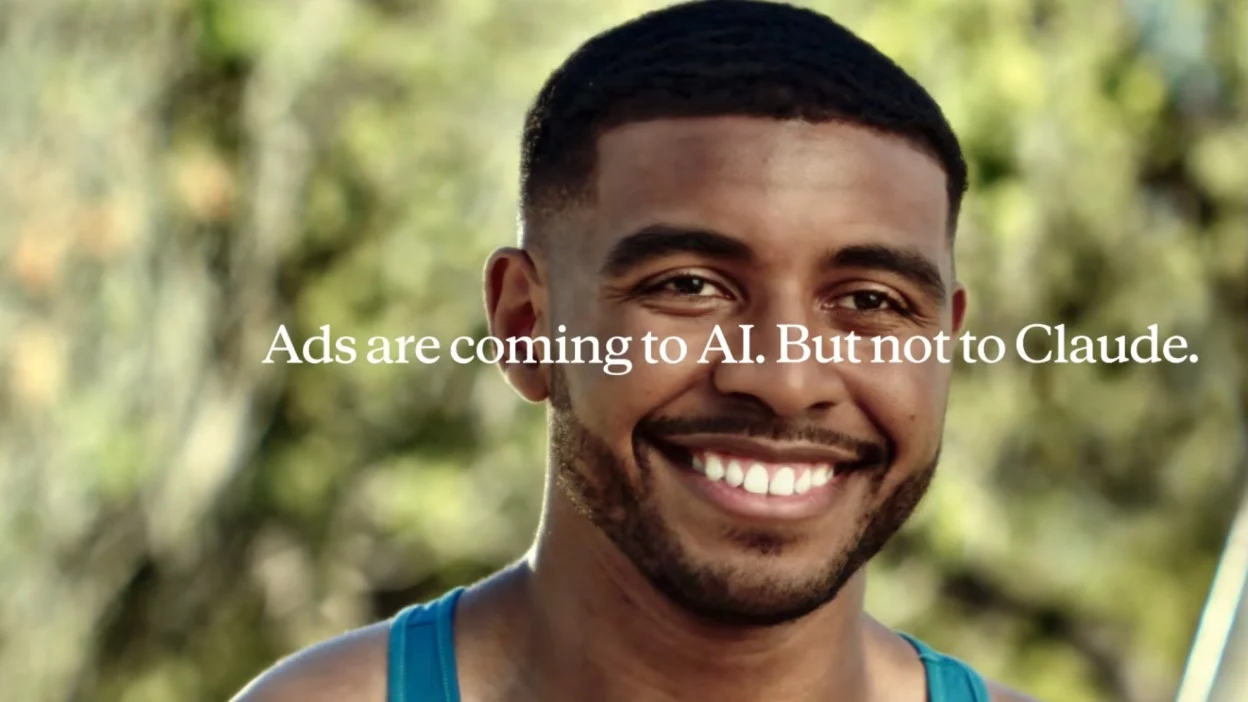
Their campaign film, “A Time and a Place,” aired around the Super Bowl broadcast and portrays users asking AI intimate questions about health, relationships, and work. The conversations are then disrupted by product recommendations, promo codes, and sponsored suggestions embedded within responses that are supposed to be neutral.
An Advertisement Criticizing Advertising
The tagline lands with precision:
“Ads are coming to AI. But not to Claude.”
A barely disguised critique: advertising may be coming to chatbots, but not here. Not with us.
It is a clear jab at ChatGPT, following recent signals that advertising could become part of its broader monetization strategy.
This creative direction immediately frames the debate. On one side, an AI positioned as a protected, almost sacred space where conversations remain neutral, non commercial, and free from advertiser influence. On the other, a future where interacting with AI could start to resemble scrolling through a sponsored feed, where the line between genuine advice and product placement becomes increasingly difficult to detect.
Anthropic never names its competitor directly, but the target is obvious.
Sam Altman Strikes Back as CEO
Sam Altman did not let the narrative stand uncontested. Writing on X, he described the campaign as amusing but ultimately misleading and accused Anthropic of misrepresenting OpenAI’s actual plans.
According to Altman, the ad depicts an intrusive advertising model that does not exist at OpenAI. He emphasized that any future advertising framework would operate under strict guardrails, with no disruptive interruptions and no deliberate confusion between sponsored content and neutral responses. Read the full response of Sam Altman here on X.
AI for Everyone or for the Elite?
Accessibility Versus Ethical Purity
Beyond brand positioning, Altman shifted the debate toward a broader societal question: accessibility. OpenAI frames its vision as "AI for everyone". If billions of people are to benefit from advanced AI systems without direct payment, advertising becomes, in this view, an economic necessity.
The implication is clear. Claude is positioned as a premium, almost luxury product aligned with ethical purity. ChatGPT is positioned as infrastructure, a scalable service designed for mass access.
On the other side, Anthropic embraces its role as the purist. No advertising, no compromise. Its argument is fundamentally ethical. Conversations with AI often involve health, finances, relationships, and other deeply personal matters. Protecting that vulnerability, Anthropic argues, is incompatible with monetizing user attention.
Who Controls the Conversation?
The confrontation between Claude and OpenAI goes far beyond a campaign clash. It is a battle over authority in the conversational economy.
If AI becomes the primary interface between individuals and information, then every recommendation, whether about medication, insurance, software, or travel, carries editorial weight.
OpenAI promises safeguards and transparency. Anthropic counters that the only truly reliable safeguard is the complete absence of advertising.
At stake is a fundamental question: who controls influence when AI mediates decision making?
Brands Facing the Great AI Divide
The End of Interruptive Advertising
For brands and agencies, this debate is far from theoretical. It raises strategic and even existential questions.
Will consumers accept a future where recommendations for medical treatments, financial products, or everyday services may be influenced by media budgets? How can brands communicate credibly in environments where AI acts as a trusted intermediary? How far will AI platforms go in rejecting certain brand requests in the name of ethics, safety, or user interest?
This moment signals a shift from the era of interruption to the era of embedded influence. Traditional advertising captures attention. AI integrated advertising has the potential to shape the decision making process itself.
For agencies, the risk is no longer producing a message that irritates. The risk is breaking the implicit truth contract between users and their AI assistants. If a brand is perceived as manipulating AI guidance, the backlash could be severe and long lasting for both advertiser and platform.
Transparency will not be a fine print disclaimer. It will be a condition for survival.
Brand Legitimacy in the AI Conversation
This feels like a turning point.
Until now, advertising has occupied public spaces such as web pages, social feeds, video platforms, and audio streams. Conversational AI introduces advertising into something much more intimate: a private dialogue where users may share highly personal information with a system they perceive as authoritative.
We are moving from visible billboards to the attentive ear of a digital confidant.
That transition demands a new level of humility from brands. Visibility alone will not justify presence. Real, demonstrable value will.
The central question is no longer simply where to place the message. It is whether a brand has the legitimacy to enter the conversation at all, and under what conditions.
The Super Bowl framed the issue with wit and strategic sharpness. The months ahead will determine which side brands choose: presence at any cost, with the risk of saturation and mistrust, or authority earned patiently through value and trust.
FAQ – Advertising and Conversational AI
Why does advertising in AI raise ethical concerns?
Because AI interactions are built on trust and often involve personal, sensitive topics. Introducing sponsored content can blur the line between neutral advice and commercial influence.
Why does OpenAI defend an advertising model for ChatGPT?
OpenAI views advertising as a potential economic lever that enables large scale accessibility, allowing advanced AI tools to reach billions without relying exclusively on paid subscriptions.
What are the implications for brands and agencies?
Brands will need to justify their presence in conversational AI environments by delivering genuine value. Failing to do so risks undermining the trust that forms the foundation of the AI user relationship.
Download our Trendbook
Our TrendBook, the fruit of the hybridization of the agency's know-how, reveals the four major trends in the media and advertising sector, deciphered by our experts:
- How to capture consumers in the age of the Messy Funnel;
- Why AI is emerging as a cultural revolution;
- How television is becoming plural;
- Why influencer marketing has reached the age of maturity.


