

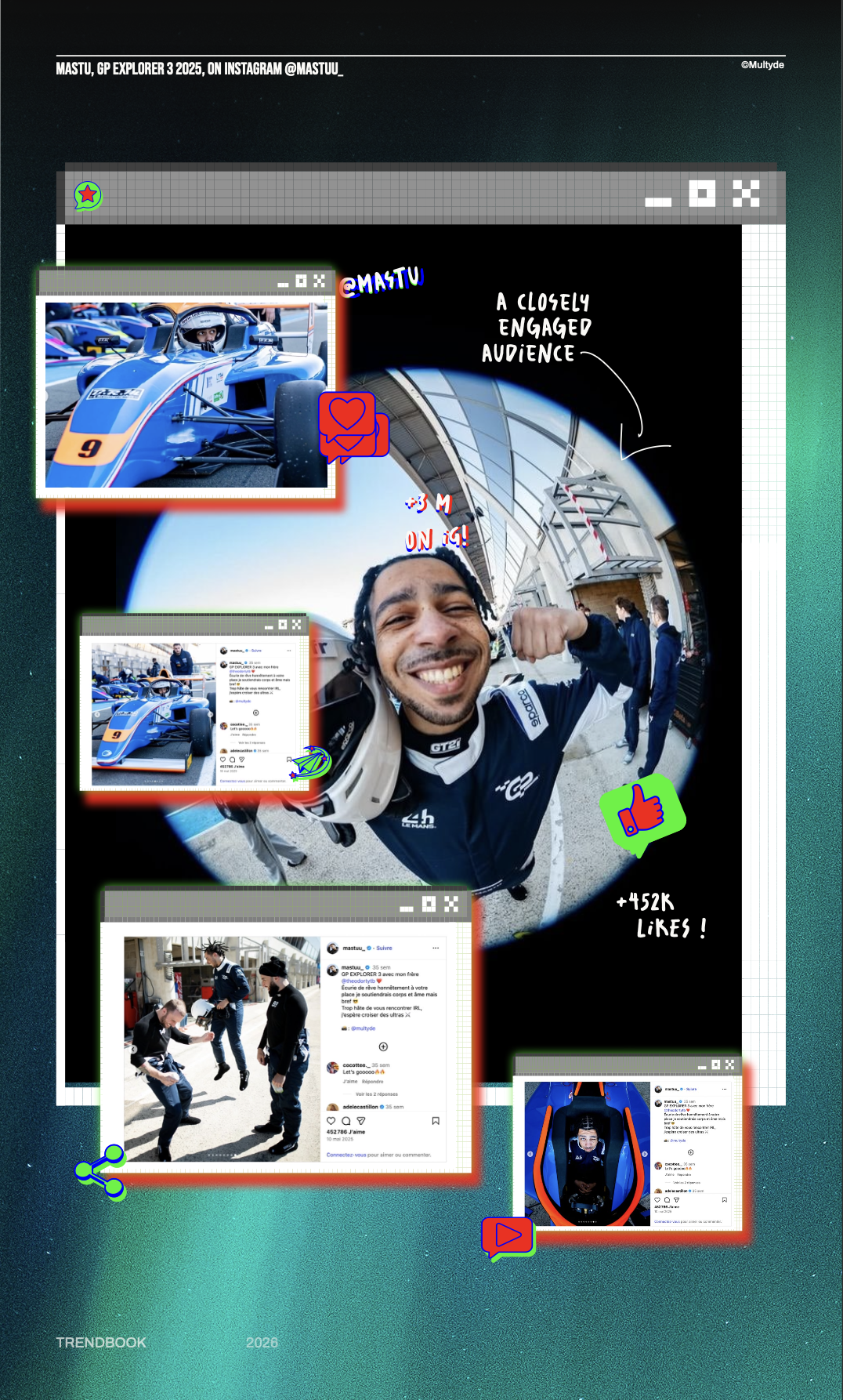
Creation, entertainment, culture, everything is blending, overlapping, transforming. Brands are no longer just communicating. They live, they breathe, they build worlds.
What’s happening in 2026 isn’t a simple evolution. It’s a structural shift that is redefining the very relationship between brands, creators, and audiences.
Marketing Is Reinventing Itself
From Advertising Transactions to Cultural Impact
For years, influencer marketing was simple: pay a creator, get a mention, measure impressions. That model is now obsolete.
Today, creators orchestrate conversations. They shape aesthetics. They spark movements that ripple across industries; music, film, sports, education, lifestyle. Everything is moving at once.
Why Visibility Is No Longer Enough
Brands that are paying attention are starting to grasp a critical truth: visibility alone is no longer something you can buy your way into.
To stay relevant, brands must become part of something bigger, cultural moments that generate emotion, entertainment, and real value.
Those who understand this shift are already seeing results that traditional advertising simply cannot deliver. Not just in reach, but in impact, memorability, and long-term engagement.
Creators Have Gained Power
From Talent to Cultural Studios
The industry has reached a tipping point.
Creators are no longer “talent” you can plug into a campaign. They operate as cultural studios: producers, entrepreneurs, and ecosystem builders in their own right.
When Creators Shape the Trends
Their deep understanding of generational codes and audience desires allows them to create experiences that extend far beyond social media.
Music festivals. Pop-up theme parks. Sports competitions. Professional leagues.
They’re no longer following trends, they’re building the infrastructure that hosts them.
What’s striking is how this rise is attracting major players far beyond traditional streaming platforms. Event giants, sports federations, production houses — all are now looking to collaborate with creators.
Why such a radical shift? What do creators offer that no one else can?
The answer lies in the nature of collaboration itself, in how value, influence, and alignment are being redefined. And understanding this new equation is exactly what we unpack in the Trendbook.
The Rule of Exclusivity Is Gone
The End of Platform Trade-Offs
Creators are no longer willing to choose between a prestigious platform and the power of social media.
That trade-off is over.
Multi-Platform Content, Creator-Controlled
And surprisingly, the biggest platforms are adapting.
Spotify, YouTube, Disney+, Netflix, they now collaborate with the same creators.
Creators set the terms. They retain ownership of their intellectual property. They decide how their content flows, where it lives, how it’s distributed, and in what format.
Negotiating in a Fragmented Ecosystem
Content no longer belongs to a single channel.
It lives everywhere, in its original form and across a network of derivatives:
short clips feeding algorithms, long-form content on streaming platforms, social snippets, platform-native adaptations.
This shift has massive implications for how brands should structure partnerships.
How do you negotiate in this environment?
How do you ensure your message lands in such a fragmented ecosystem?
How do you measure success when control is no longer centralized?
These questions require a new strategic approach, one we break down in detail in the Trendbook.
Physical Experience Is Making a Comeback
The Return of Real-World Connection
In a digital-first world, the paradox is clear: the desire for real-life experiences has never been stronger.
Fans want to show up. Meet. Buy. Celebrate.
Engagement is no longer confined to screens.
The Strategic Role of Brands in These Experiences
Creators’ cultural projects now extend into events, pop-ups, meetups, festivals, and premieres.
These moments become hubs of community and emotional activation.
For brands that support these experiences, the impact goes far beyond what digital content alone can achieve.
But this raises critical questions:
How should brands show up without being intrusive?
What role can they play authentically?
How do you measure real impact in physical spaces?
These are now strategic challenges brands must solve.
Brands Must Reinvent Themselves
From Advertisers to Cultural Platforms
The most successful brands understand one thing: they must completely rethink their approach.
Without strong identity, storytelling, and native video formats, they simply don’t matter in today’s cultural conversation.
Scaling Transformation Without Losing Credibility
Brands are turning their social channels into full-fledged cultural platforms.
They adopt the codes of the creator economy:
immersive storytelling, native formats, humor, behind-the-scenes content, editorial series.
It’s no longer about posting, it’s about building worlds that capture attention and sustain engagement.
But transformation isn’t just tactical, it’s structural.
How do you make this shift?
What codes should you adopt?
How should your teams be organized?
How do you measure success without losing authenticity?
These answers require more than theory, they demand real use cases and strategic depth.
Six Major Revolutions
In this rapidly evolving landscape, six major revolutions are reshaping the rules of cultural marketing.
You can already see the signals.
You’re observing the moves from leading brands.
You can feel that something is changing.
But understanding how these shifts connect, how they create tangible, strategic opportunities, is a different challenge entirely.
Each revolution unlocks new potential.
Each demands a tailored approach.
Each carries risks if misunderstood.
Download the Trendbook 2026
Cultural marketing in 2026 is being completely redefined.
Brands that understand this transformation early will gain a decisive competitive edge.
Download the Trendbook 2026 to discover:
- The six major revolutions reshaping the landscape
- How they connect and amplify each other
- How to implement them concretely
- How to stay competitive in this new ecosystem
The time to act is now.
FAQ — Cultural Marketing & Influence in 2026
What is cultural marketing in 2026?
Cultural marketing is about building lasting cultural connections between brands, creators, and audiences.
In 2026, it goes beyond advertising logic and embeds itself into ecosystems of creation, entertainment, and real-world experiences where brands participate in narratives instead of broadcasting messages.
Why have creators become central to brand strategy?
Creators understand the cultural, generational, and narrative codes of their communities.
They no longer just produce content, they design experiences and build cultural ecosystems.
This makes them strategic partners, not just distribution channels.
How can brands succeed in cultural marketing?
Brands must move away from transactional thinking and toward value-aligned collaboration.
This means co-creating with creators, investing in culturally credible formats, and measuring success beyond visibility, focusing on impact, engagement, and long-term resonance.
Download our Trendbook
Our TrendBook, the fruit of the hybridization of the agency's know-how, reveals the four major trends in the media and advertising sector, deciphered by our experts:
- How to capture consumers in the age of the Messy Funnel;
- Why AI is emerging as a cultural revolution;
- How television is becoming plural;
- Why influencer marketing has reached the age of maturity.


